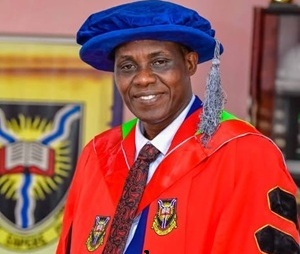
UI DON SAYS POOR PERFORMANCE, INEQUALITY, AND EDUCATIONAL FAILURE, ARE NOT IMMUTABLE DESTINIES
A professor of Mathematics Education and Educational Evaluation at the Instutute of Education, University of Ibadan, Professor Joshua Oluwatoyin Adeleke has submitted that poor performance, inequality, and educational failure are not immutable destinies but diagnosable and remediable challenges.
He made this submission while delivering the 612th inaugural lecture of the University of Ibadan on behalf of the Institute of Education.
The lecture which was the ninth in the series of inaugural lectures for the 2025/2026 academic session was entitled "Mathematics Education and Educational Evaluation: The Foundations of Hope for Societal Transformation."
Professor Adeleke said when teaching is informed by valid evaluation, when learning is supported by appropriate cognitive preparation, and when policy is guided by credible data, education becomes a powerful engine for national development.
He described Mathematics Education and Educational Evaluation as instruments of hope, justice, and societal transformation.
He explained that Mathematics Education equips individuals with structured reasoning, problem solving capacity and intellectual resilience while Educational Evaluation provides the empirical compass that guides systems toward equality, equity, and accountability.
The Don added that Mathematics Education nurtures disciplined inquiry, while Educational Evaluation ensures that this inquiry is purposeful, fair, and impactful.
He stated that when these two forces converge, education transcends rote instruction and becomes a transformative social enterprise and together, they form the architecture upon which resilient learners, empowered teachers, and accountable institutions are built.
He suggested that as Nigeria, Africa, and the global community confront complex educational and societal challenges the message should be clear that societies rise or fall on the strength of their educational evaluation systems and the quality of their Mathematics Education.
Professor Adeleke advised that by committing to rigorous research, ethical assessment, innovative pedagogy, and sustained capacity building, education can truly fulfil its mandate as the greatest instrument of hope and the most enduring pathway to societal transformation.
He, therefore, recommended that monitoring and evaluation should be expanded beyond formal schooling; diagnostic and formative assessment practices should be institutionalised; while digital tools should be employed for innovative teaching and assessment.
The Inaugural Lecturer also recommended the sustenance of capacity building and mentorship in educational research; the advancement of equity focused evaluation to address gender and social gaps; as well as investment in research-driven curriculum and instructional design.